Publish Date: 04-07-2026
Auto Insurance
Does Car Insurance Cover Pothole Damage?
Quick Answer: Does Car Insurance Cover Damage Caused by a Pothole?
Yes, car insurance may cover pothole damage if you carry collision coverage.
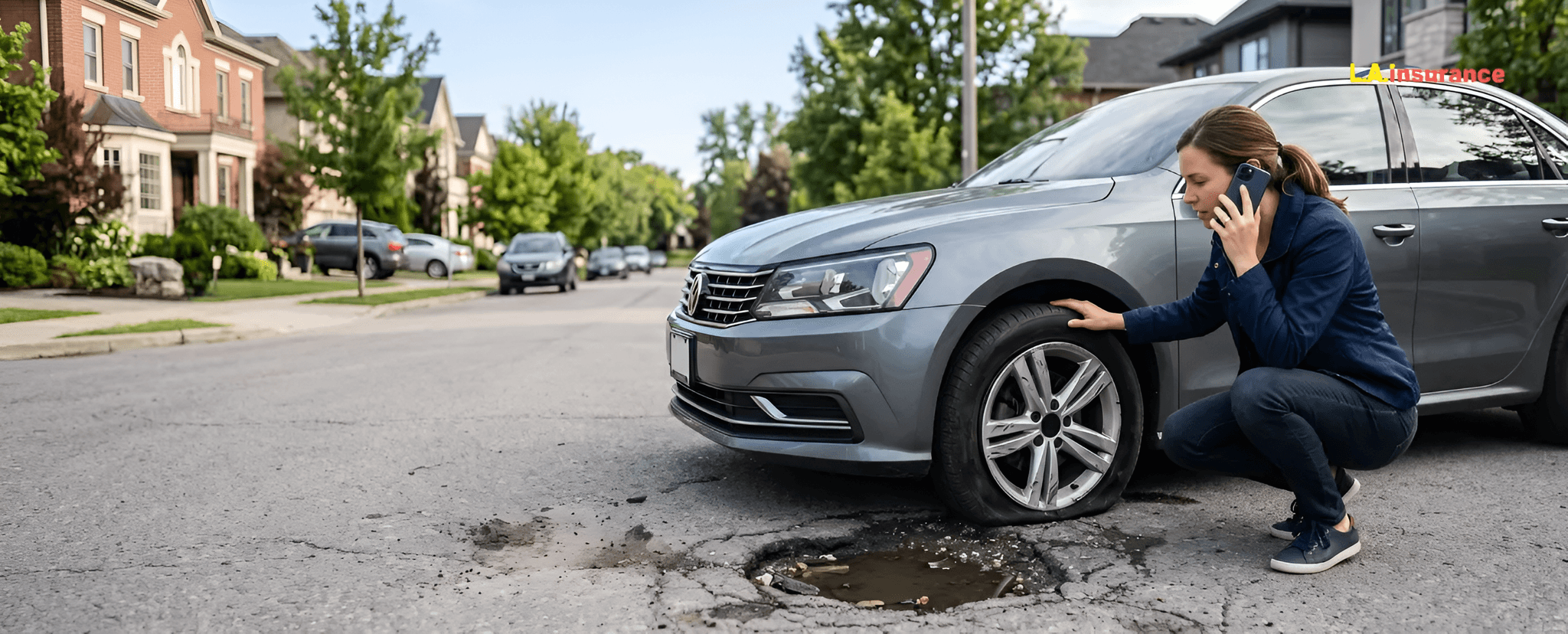
Hitting a pothole is generally treated as a collision claim because your vehicle strikes a road hazard. If the impact damages your tires, wheels, suspension, steering components, or undercarriage, your insurer may help pay for repairs after you meet your deductible.
However, coverage does not automatically mean filing a claim is the best choice. If repair costs are close to or lower than your deductible, paying out of pocket may make more financial sense.
Why Insurance Treats Pothole Damage as a Collision Claim
Many drivers assume pothole damage falls under comprehensive coverage because weather and poor road conditions often contribute to potholes. However, insurers typically classify pothole damage as a collision claim.
The reason is simple. A pothole becomes a road hazard when your vehicle strikes it. From an insurance perspective, the damage results from an impact rather than a maintenance issue or a non-collision event.
For example, if your tire blows out after hitting a deep pothole or your suspension is damaged by the force of the impact, the claim would usually fall under collision coverage, not comprehensive coverage.
This distinction matters because collision claims are subject to your deductible. If you only carry liability insurance, pothole damage to your own vehicle is generally not covered.
What Types of Pothole Damage Does Insurance Usually Cover?
A pothole can do more than puncture a tire. In severe cases, the impact can affect multiple parts of the vehicle at once. If you have collision coverage, insurance may help pay for repairs to several types of pothole-related damage.
Tire Damage
Tires are often the first part of the vehicle affected by a pothole.
A sudden impact can cause:
- Sidewall bulges
- Tire punctures
- Blowouts
- Internal tire damage
Insurance may cover tire damage when it results directly from a covered pothole impact. However, insurers generally will not pay for tires that fail because of normal wear, age, or poor maintenance.
If only one tire is damaged, insurers may pay to replace the damaged tire rather than an entire set, depending on the policy and repair recommendation.
Bent or Cracked Rims
A deep pothole can force the wheel into the edge of the road surface with enough force to bend or crack a rim.
Common signs include:
- Air leaking from the tire
- Steering wheel vibration
- Visible wheel damage
- Difficulty maintaining tire pressure
Because rim damage results directly from the impact, it is commonly covered under a collision claim.
Wheel Damage
Although many drivers use the terms wheel and rim interchangeably, a pothole can damage the entire wheel assembly.
In more severe impacts, the wheel structure itself may be compromised, affecting how the tire sits on the vehicle.
Insurance may cover wheel replacement when the damage is directly linked to the pothole incident and exceeds your deductible.
Suspension Damage
Suspension damage is one of the most expensive pothole-related repairs.
The force of the impact can affect components such as:
- Struts
- Shocks
- Control arms
- Ball joints
- Suspension links
A vehicle with suspension damage may feel unstable, ride roughly, or produce unusual noises after hitting a pothole.
Because these repairs can cost hundreds or even thousands of dollars, drivers often find themselves comparing repair costs against their deductible before deciding whether to file a claim.
Steering and Alignment Damage
Not all pothole damage is immediately obvious.
You may drive away without noticing a problem, only to discover days later that the vehicle:
- Pulls to one side
- Vibrates at higher speeds
- Has an off-center steering wheel
- Experiences uneven tire wear
A pothole impact can knock the vehicle out of alignment or damage steering components. If an inspection confirms the damage resulted from the pothole strike, collision coverage may help pay for repairs.
Undercarriage Damage
Large potholes can cause the underside of a vehicle to hit the road surface.
This type of impact may damage:
- Protective panels
- Exhaust components
- Fuel system components
- Structural parts underneath the vehicle
Undercarriage damage is often harder to identify without a professional inspection. In some cases, drivers do not discover the damage until weeks after the incident.
That is why it is important to inspect your vehicle after a significant pothole impact, even if no obvious damage is visible right away.
What Pothole Damage Is Not Covered by Insurance?
Even if you have collision coverage, not every repair will qualify for reimbursement. Insurance is designed to cover sudden and accidental damage caused by the pothole itself. It does not cover existing problems that were already present before the incident.
Examples of damage that is typically not covered include:
- Normal tire wear and tear
- Tires that were already bald or damaged
- Pre-existing alignment issues
- Suspension problems unrelated to the pothole
- Mechanical failures caused by age or lack of maintenance
For example, if a pothole exposes a worn suspension component that was already failing, the insurer may only cover damage directly caused by the impact, not the underlying wear-related issue.
The same principle applies to tires. If a pothole causes a blowout, coverage may apply. However, if the tire fails primarily because it was severely worn, the claim could be denied.
Will Insurance Pay for a Flat Tire Caused by a Pothole?
In many cases, yes.
If a pothole causes a flat tire, blowout, or other sudden tire damage, your collision coverage may help pay for repairs or replacement after your deductible is met.
However, whether filing a claim makes sense is another question.
A single damaged tire often costs less than many collision deductibles. For example, if replacing the tire costs $250 and your deductible is $500, insurance would not pay anything toward the repair.
This is one reason many drivers choose to pay for minor tire damage themselves rather than open a claim.
If the pothole damages multiple tires, bends a wheel, or causes additional suspension damage, the total repair cost may be high enough for a claim to become worthwhile.
You can learn more about tire-related claims in our guide to does car insurance cover flat tires.
Should You File an Insurance Claim for Pothole Damage?
The answer depends on the extent of the damage, your deductible, and the estimated repair cost.
Many drivers assume any covered damage should be reported to insurance. In reality, filing a claim is often a financial decision.
According to AAA, the average pothole-related repair costs about $406. If your collision deductible is $500, filing a claim may provide little or no benefit for a typical repair.
On the other hand, potholes can sometimes cause extensive wheel, suspension, and steering damage that costs far more than the deductible.
Before filing a claim, consider:
- The total repair estimate
- Your collision deductible
- Whether multiple vehicle components were damaged
- Whether the vehicle is safe to drive
- Your insurer's claims history considerations
When Filing a Claim May Make Sense
Filing a claim may be worth considering when:
- Repair costs significantly exceed your deductible
- Multiple parts of the vehicle were damaged
- Suspension or steering repairs are required
- The vehicle is unsafe to drive
- You cannot comfortably afford the repairs yourself
For example, a pothole that damages a tire, bends a rim, and affects the suspension could result in repairs costing well over $1,000. In that situation, insurance may substantially reduce your out-of-pocket expenses.
When Paying Out of Pocket May Be the Better Option
Paying for repairs yourself may make more sense when:
- Repair costs are lower than your deductible
- The damage is limited to a single tire
- The repair is relatively inexpensive
- You want to avoid opening a small claim
For instance, if a pothole causes $300 worth of tire damage and your deductible is $500, filing a claim would likely provide no financial benefit.
This is why many drivers compare the repair estimate against their deductible before deciding whether to file a claim.
How Your Deductible Affects a Pothole Damage Claim
Your deductible plays a major role in determining whether filing a pothole damage claim is worth it.
An auto insurance deductible is the amount you must pay out of pocket before your collision coverage begins paying for covered repairs.
For example, if pothole damage results in a $1,500 repair bill and your deductible is $500, your insurer may cover the remaining $1,000.
However, if the repair costs $400 and your deductible is $500, insurance would not contribute toward the repair because the damage falls below your deductible amount.
That’s why many drivers compare repair estimates against their deductible before filing a claim. A claim may make financial sense when repair costs significantly exceed the deductible, but smaller repairs are often paid out of pocket.
Can a Pothole Claim Increase Your Insurance Rates?
It can, but not always.
Insurance companies consider many factors when determining rates, including your claims history, driving record, location, and the severity of the claim.
Because pothole damage is usually handled as a collision claim, it becomes part of your claims record. Some insurers may view multiple claims within a short period as a greater risk factor than an isolated incident.
That said, there is no universal rule that says a single pothole claim will automatically raise your premium. The outcome varies by insurer and your overall claims history.
This uncertainty is one reason some drivers choose not to file smaller claims that barely exceed their deductible.
If you have accident forgiveness on your policy, it may help prevent a covered claim from affecting your premium. However, eligibility rules vary by insurer, so it is important to review your policy details before assuming a claim will be forgiven.
What Should You Do Immediately After Hitting a Pothole?
The moments after hitting a pothole can help determine both your safety and the strength of a future insurance claim.
If it is safe to do so:
- Pull over and inspect your vehicle.
- Check for obvious tire, wheel, or undercarriage damage.
- Take photos of the pothole and the surrounding roadway.
- Photograph any visible vehicle damage.
- Make note of the location, date, and time.
- Watch for warning signs such as vibrations, pulling, unusual noises, or tire pressure loss.
- Obtain a repair estimate as soon as possible.
Even if the vehicle appears fine, it is still a good idea to monitor how it drives over the next several days. Some types of pothole damage are not immediately noticeable.
If you ultimately decide to file a claim, detailed photos and repair documentation can help support your case. Our guide on how to file a claim after a car accident explains what insurers typically look for during the claims process.
Can Hidden Pothole Damage Appear Days Later?
Yes.
Not all pothole damage shows up immediately after impact.
In some cases, drivers continue using their vehicles without noticing a problem until days or even weeks later.
Common delayed symptoms include:
- Steering wheel vibration
- Vehicle pulling to one side
- Uneven tire wear
- Clunking or rattling noises
- Reduced ride comfort
- Tire pressure that gradually drops over time
These issues can occur when the pothole damages suspension, steering, wheel, or alignment components that are not easily visible during a roadside inspection.
For this reason, it is worth having the vehicle inspected if you hit a pothole hard enough to jolt the car, even if there are no obvious signs of damage at first.
Documenting the incident and seeking an inspection promptly may also help if you later decide to pursue an insurance claim or reimbursement request.
Can Severe Pothole Damage Total a Vehicle?
Although it is uncommon, severe pothole damage can sometimes result in a total loss.
Most pothole claims involve tires, wheels, or suspension components. However, a particularly deep pothole or a high-speed impact can cause extensive damage to multiple systems at once.
According to AAA, pothole-related vehicle repairs cost U.S. drivers an estimated $26.5 billion in a single year, with the average repair bill approaching $600. While many repairs are relatively minor, some incidents result in much more significant damage.
A vehicle may be declared a total loss when the cost of repairs approaches or exceeds its actual cash value.
This is more likely to occur when:
- The vehicle is older and has a lower market value.
- Multiple suspension and steering components are damaged.
- Structural damage occurs underneath the vehicle.
- Expensive parts require replacement.
For example, a repair bill that might be manageable on a newer vehicle could exceed the value of an older car, leading the insurer to declare it a total loss instead of paying for repairs.
While total loss pothole claims are rare, they can happen when the damage is severe enough and the vehicle's value is relatively low.
Can You Get Reimbursed by the City, County, or State for Pothole Damage?
Possibly, but reimbursement is often more difficult than many drivers expect.
In some situations, the government agency responsible for maintaining the road may compensate drivers for pothole-related vehicle damage. However, approval is not automatic. Most agencies require evidence that they were responsible for the roadway and had a reasonable opportunity to repair the pothole before the damage occurred.
The process also varies by state, county, and municipality. Some agencies have formal claim procedures and filing deadlines, while others may limit liability under state laws that protect government entities from certain lawsuits.
When a Government Agency May Be Responsible
A government agency is generally more likely to be held responsible when it knew, or reasonably should have known, about a dangerous pothole and failed to address it within a reasonable period.
For example, a city may receive multiple complaints about the same pothole over several weeks but fail to repair it. If that pothole later causes vehicle damage, the agency may face a stronger reimbursement claim than it would for a newly formed pothole that appeared shortly before the incident.
That said, every case is different. Even when a pothole causes significant damage, drivers often need to prove that the agency had notice of the hazard and sufficient time to respond.
What Evidence Will You Need for a Pothole Damage Reimbursement Claim?
Documentation can play a major role in whether a reimbursement claim succeeds.
The more evidence you can provide, the easier it may be to demonstrate both the existence of the pothole and the damage it caused. Gathering information immediately after the incident can strengthen your claim later.
Helpful documentation may include:
- Photos of the pothole
- Photos of vehicle damage
- The location of the incident
- The date and time the damage occurred
- Repair estimates and invoices
- Inspection reports
- Witness statements, if available
Some government agencies may also ask for proof of ownership, insurance information, or additional documentation before reviewing the claim.
Should You File with Insurance or Seek Government Reimbursement?
In many cases, drivers choose to notify their insurer first because insurance claims are often resolved faster than government reimbursement requests.
A reimbursement claim against a city, county, or state can take weeks or even months to review. There is also no guarantee that the agency will accept responsibility or approve payment.
If you have collision coverage and the damage is significant, filing an insurance claim may help you get repairs completed sooner. If the government later reimburses the damage, the insurer may recover some or all of its costs through a separate process, depending on the circumstances.
How to File a Pothole Damage Insurance Claim
If you decide that filing a claim makes financial sense, acting quickly can help support your case.
Start by documenting the pothole, the location, and any visible vehicle damage. Take clear photos and keep records of repair estimates, inspection reports, and receipts. The more information you can provide, the easier it may be for the insurer to evaluate the claim.
Next, contact your insurance company and explain what happened. Be prepared to describe when and where the incident occurred, the damage you observed, and whether the vehicle remains safe to drive. Your insurer may ask for photos, repair estimates, or an inspection before approving repairs.
After the claim is submitted, the insurance company will review the damage and determine whether it is covered under your policy. The timeline varies by insurer and the complexity of the claim, but keeping detailed documentation can help prevent unnecessary delays.
Learn more: How long does a car insurance claim take?
FAQs About Does Car Insurance Cover Pothole Damage
Is Pothole Damage Covered by Collision or Comprehensive Insurance?
Pothole damage is typically covered by collision insurance. Insurers generally treat a pothole as a road hazard that your vehicle strikes, making it a collision claim rather than a comprehensive claim.
Does Full Coverage Insurance Cover Pothole Damage?
Yes, if your full coverage policy includes collision coverage. Since full coverage usually combines liability, comprehensive, and collision insurance, pothole damage is generally covered under the collision portion of the policy.
Is It Worth Claiming Pothole Damage on Insurance?
It depends on the repair cost and your deductible. Filing a claim may make sense when repairs significantly exceed your deductible, but smaller repairs are often less expensive to pay out of pocket.
Does Insurance Cover Alignment Damage Caused by a Pothole?
Yes, collision coverage may cover alignment damage if it was caused by the pothole impact. An inspection may be required to confirm the damage resulted from the incident.
Does Insurance Cover a Bent Rim from a Pothole?
Yes, a bent or cracked rim caused by a pothole is typically covered under collision insurance. Coverage is subject to your deductible and policy terms.
Can a Pothole Damage My Suspension?
Yes. A severe pothole impact can damage suspension components such as struts, shocks, control arms, and ball joints. Suspension repairs can be among the most expensive types of pothole damage.
How Long Do I Have to File a Pothole Damage Claim?
The deadline varies by insurer and state. While policies often allow a reasonable amount of time to report damage, it is best to notify your insurer as soon as possible after the incident.
Can I File a Claim If I Did Not Take Pictures of the Pothole?
Yes. Photos can strengthen your claim, but they are not always required. Repair estimates, inspection reports, and other evidence may still help support your claim.
Will a Pothole Claim Affect My No Claims Discount or Insurance Premium?
Possibly. A pothole claim becomes part of your claims history, which may affect future premiums or discounts. However, the impact varies by insurer, policy, and overall claims record.
Can You Sue the City for Pothole Damage?
In some cases, yes. However, you generally must show that the government agency responsible for the road knew or should have known about the pothole and failed to repair it within a reasonable period.
Editorial Disclaimer
The resources on this blog are researched and created by experienced insurance writers, then fact-checked and verified for accuracy to provide clear, general informational guidance. This content does not constitute professional insurance, legal, or financial advice. Coverage options and premium rates are subject to individual eligibility, underwriting guidelines, and state availability. For specific questions regarding your policy or to get an accurate quote, please contact a licensed L.A. Insurance agent directly. We're an independent agency and not a direct insurance carrier. For more information on how we operate and handle your data, please see our Terms and Conditions and Privacy Policy.
Tag :
fast car insurance
cheap car insurance
car maintenance

Is Gap Insurance Worth It on a Second-Hand Car?
Yes, gap insurance can be worth it on a used car if you owe more on your auto loan than the vehicle is worth. This situation is known as negative equity or an upside down car loan.
Does Car Insurance Cover Pothole Damage?
Yes, car insurance may cover pothole damage if you carry collision coverage.

How Much is Motorcycle Insurance in Colorado?
If you’re shopping for motorcycle insurance in Colorado, the first thing that comes to concern is the cost.

Are Older Cars Cheaper to Insure?
Older cars are often cheaper to insure because they typically have a lower vehicle value and may cost less for an insurance company to replace after a covered loss.

How Long Will Insurance Pay for a Rental Car After an Accident
After an accident, insurance typically pays for a rental car until your vehicle is repaired, your rental coverage limit is reached, or your claim is settled if the car is declared a total loss.

Does Renters Insurance Cover Temporary Housing?
Ever wondered what you’re going to do if your rental unit suddenly becomes uninhabitable after a storm, short circuit, an accidental fire, or burst water pipes?